Dingle Film Festival 2010

The 4th Annual Dingle Film Festival is almost upon us, and the line up looks quite interesting. Cillian Murphy is coming to town for the screening of Perrier’s Bounty, there will be seminars with Tom Johnson, one of the world experts on sounds, as well as a 4K/RED/DCI seminar for those interested in digital. Paddy Breathnach and Rob Walpole will be talking about their Irish film ‘I Went Down,’ and there will be screenings of film for the duration of the festival.
If you’re interested, there’s a schedule here. If this amazing weather holds, however, I’m guessing there might be a few film buffs who just might not be able to bring themselves to stay indoors!
Technorati tags: Dingle, film, festival, cinema, movie, Kerry
Cattle in Ancient Ireland
I’ve been working on an article on milk, which I think will be in next week’s Irish Times magazine. I did a fair bit of research, including reading a fascinating book, Cattle in Ancient Ireland, by A.T. Lucas. It’s amazing how intertwined milk cows are with Irish history, and our literature and historical tracts are full of cows. Professor Lucas writes, “It must be emphasised that these thousand of allusions (in ancient literature) are not to cattle in general but specifically to cows and more specifically to cows as yielders of milk. There are no beef-eating heroes in Irish literature; the doughtiest Irish warriors relied on pig-meat for their intake of protein.”
The importance of both cows and milk in Ireland is the basis for the article, along with my belief that we have the best milk in the world. Since there were far too many interesting tidbits in the book (and that was only one part of my research!) for a relatively short piece, I thought I’d put some of it here.
10 Things You Might Not Know About Cows and Ancient Ireland
1. The milk cow was the highest unit of currency under Brehon law, and Lucas writes, “The cow was the measure of everything: it was the unit of value; the ultimate in poverty was the man with only one cow; the wealth of the richest consisted of vast herds of them.”
2. There was a practise of bathing new-born infants in milk. St. Brigid was the daughter of a bondsmaid, and her mother was sent out to get milk, then “the maidservants washed St. Brigid with the milk that was still in her mother’s hand.”
In 1171, Henry II arrived in Ireland and insisted on reforms including that babies be baptised in churches. From the Chronicle of the Reign of Henry II: “For it was formally the custom in various parts of Ireland that immediately a child was born, the father or some other person immersed it three times in water and, if it was the child of a rich man, he immersed it three times in milk.” There us no suggestion that this bathing was a Christian baptismal rite.
3. It seems there was a tradition of not letting the calves go to their mothers after the death of an important person, so that they, missing their mother, joined in the keening, or wailing. In Cogadh Gaedhel re Gallaibh, describing the death of Brian Boru’s brother, it states: “Calves are not suffered to go to the cows, in lamentation for the noble Mathgamhain.”
From the Annals of Ulster, under 737: “Cernach, son of Fogartach, is treacherously slain by his own wicked associates, whom the calves of the cows, and the women of this lower world in long continued sadness bewailed.”
4. Buachaill, the Irish word for boy, comes from cowherd.
5. It was believed that a cow deprived of her calf would retain her milk. There are many stories about calves being separated and what had to be done to get the mother to give milk (in one miracle, the wolf who killed a calf allows the cow to lick it as she would her calf, at which point the cow gives milk). So, much of dairying had to do with keep the calf close by and yet not letting it drink all the milk. Stuffed calf skins were used later on.
6. There was a strange tradition, recorded on the Iveragh Peninsula, that when cows became ill after calving (reducing their milk), women blew three puffs of their breath into the cow’s vaginia as a therapeutic treatment. This is echoed in Herodotus talking of the Scythians: “…they insert a tube made of bone and shaped like a flute into the mare’s genitals… and while one blows, another milks.” It’s also echoed in Al0’Ubaid, from 2500BC, where milkers are shown in profile sitting behind the cows with their mouths adjacent to the genital region of the animals.
7. Cattle were brought to burials. There is a reference in Annals of Connacht to Domhnall O Conchobhair, who was killed in 1307 and buried at Boyle Abbey, Co. Roscommon: “He was taken to the Curlieu hills, and never in that age was there brought with any corpse so many droves and flocks of cattle and companies of horse and food and mercenaries as we brough with him to his burial.”
8. Cows not only defined wealth, but they were used as currency. They made up all or part of a bride-price. When a king of Tara married the daughter of the King of Offaly, he promised four score cows, two score at once, and two score not later than the next May Day.
9. Poets charged for their work in cows. The law tract Uraicecht Becc details the payments due to various grades of poets for their poems, ranging from one cow to ten cows (which tells you how valuable poems were at the time!).
10. Cattle raiding was common place. After all, our great epic, The Tain, is about a cattle raid. Creach, a word said to have originally meant marking or branding, is used as a reference to both the raid itself and for the intended prey.
Oisin, lamenting the quiet life says:
No courting or hunting, the two crafts we looked forward to
no fighting no raiding, no learning of athletic feats.Gan bheit ag suirghe ag seilg
in dá cheird le a raibhe ar súil
gan deabaidh gan denamh creach
gan beith ag foghluim cleas luith.
Even the saints shared the plunder of raids. St. Caillin of Fenagh is depicted as insisting on a fat cow from every prey from each son of a king and chieftain.
Changing Times
Christophe, our steadfast ice cream maker, who has been with us for almost 10 years and was our second hire as a company, is leaving us to open a restaurant on the tiny South Pacific island of Futuna. He is from that part of the world (New Caledonia), and I can certainly understand the attraction to heading back to balmy winds, hot sun and white sands.
We’ll miss him very much. He has brought so much to Murphys Ice Cream over the years and been a guardian of our quality. We owe him a debt of gratitude and wish him well.
This means that we will be short an ice cream maker, and we will be hiring.
If you are interested or know of someone who would like to live in beautiful Dingle (or does already) and make ice cream for a living, please email our production manager, JP Houlihan, with a cover letter and CV.
Bonne chance, Christophe!
Bridgestone Food Guide 2010
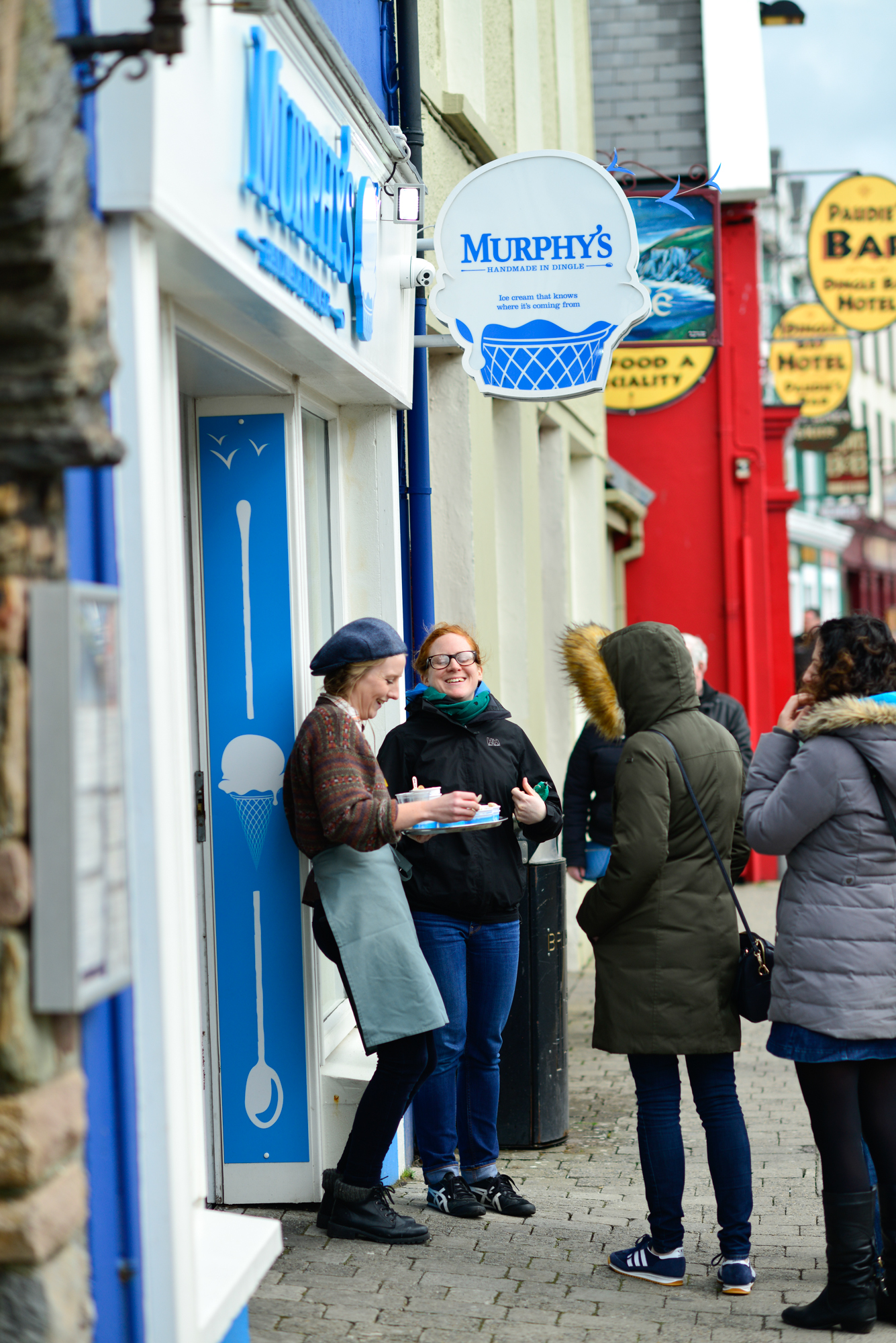
We have received a box of the new Bridgestone Food Guide for our shops, and John & Sally McKenna’s book is a must for anyone who loves Irish food. I’m not just saying this because we’re still blushing here at the write up of our shops (photo above). This is the most comprehensive list of the best of Irish foods (by a long way), with where to go and what to find in all parts of the country. The work that went into this was clearly immense, and it’s written with love, care and dedication.
I suggest you order it immediately. Better still, hie yourself down to your local bookshop and pick up a copy. From the sound of it, Irish bookshops need all the help they can get.
Technorati tags: Irish, Bridgestone, food, guide, Ireland, McKenna
Sea Salt Ice Cream
Here’s one of our new flavours. I think there are many uses for sea salt ice cream – it can really lift the flavour of a range of desserts, and we’ve brought it in to complement our new caramel and dark chocolate flavours. It’s certainly caught people’s imaginations, and it’s selling better than I would have thought.
It’s a simple recipe to make, but I do have a caution in that various salts can taste so different, so depending on the salt you use, you might well need to adjust the recipe. I don’t think it should be too salty – just enough to boost other flavours.
I made my own sea salt. If you’re near the sea and have the inclination, here’s how I did it.
MURPHYS SEA SALT ICE CREAM
Ingredients:
• 120g sugar
• 5 egg yolks
• 220 ml cream
• 220 ml milk
• 2 teaspoons sea salt
What to do:
1. Beat the sugar and egg yolks and until it thickens and lightens in colour.
2. Bring the milk to a low simmer.
3. Beat the milk into the egg/sugar mixture in a slow stream.
4. Pour the mixture back into the pan and place over low heat.
5. Stir continuously until the custard thickens slightly (around 65-70C) and just coats the back of a spoon. Don’t over-heat, though, because at around 76C you will scramble the eggs!
6. Immediately remove from the heat.
7. Allow to cool.
8. Stir in the salt.
9. Whip the cream until it has doubled in volume (you should have soft peaks – don’t over-whip).
10. Fold (gently stir) in the custard.
11. Freeze using a domestic ice cream machine.
You can also just cover and place in the freezer, stirring every few hours.
Notes:
1. Again, you may need to adjust the quantity of salt depending on which salt you use. We also really like Maldron salt, but I’d use about 20% less, since it’s saltier than Dingle sea salt!
2. To pasteurise the eggs, heat the custard to 73C and maintain that temperature for at least 5 minutes. Use a cooking thermometer, though, and keep stirring! If the custard goes any higher than 76C, the eggs will scramble. Immediately cover and place in the freezer until cool.
Making Sea Salt
One of our new ice creams for our new flavour array is sea salt ice cream, and I got to wondering how it would taste with salt made from our local Dingle sea water. So, the other day I decided to make salt.
It started with a trip to the beach, which is never a bad thing, especially on a sunny day. I took along the partner and the little one, and we made an afternoon of it.

Róisín is a bit too young to be interested in the science part of making salt, but she sure loved the fresh air and looking at the waves.
I’m thinking kids a bit older would enjoy such a project and would be quite amazed to see solid white crystals appearing out of a clear liquid, though they would need a bit of patience. If you want to try it, here’s what I did.
How to Make Sea Salt
1. I started with 5 litres of Dingle sea water (note – make sure the area where you get your water is clean and free from pollution).

2. I passed the water through a coffee filter to make sure there was no sand or tiny bits of seaweed.
3. I boiled the water in a large pot until the salt had begun to crystalise and there was about an inch of liquid left (you might need to scrape the bottom of the pot now and then as the salt begins to form). This takes several hours and produces a lot of steam!
4. I turned off the heat and left it uncovered to evaporate overnight. I don’t know if this is necessary, but I didn’t want to burn the salt by mistake.
5. In the morning, the water was gone, but the salt was still moist. I spread it on a baking tray and put it in the oven at 100C for an hour, at which point the salt was dry.
6. That’s it! The yield was about 200 grams of Dingle sea salt (photo top)!
The salt has quite an interesting flavour – more delicate than I would have thought. You can taste the mineral content, and it oddly has a hint of sweetness. Now, I’ll have to turn it into ice cream!
P.S. I was just informed by a science teacher that if you dangle a string into the boiling seawater, once it’s reduced a bit, maybe attached to a rod that can sit on the pot and with a weight tied on the end in the water, that the salt crystals grow on the string. That might have more dramatic effect if you’re making it with kids. I’ll try it next time.
Our New Resident Busker?
I was in Killarney this morning, and I took this photo of a new busker who has appeared in the alley just beside our shop. I was most impressed, since I play a bit of fiddle myself, but I’ve never seen a violin-trumpet! I think he said he made the instrument himself, but his English isn’t great, and I might have misunderstood.
Still, it’s a fun addition to the street and much more enjoyable in my eyes than the usual dancing leprechauns!
10 Things to Give Up for Lent
As we head into Lent, here’s my third “Things to Give Up” list.
As anyone who has followed this blog knows, I’m very fond of chocolate and feel it’s not really the best thing to give up, especially since the Vatican made a pronouncement in 1662, specifically allowing it (at least in drinking form – more here). Besides the panic I feel at the thought of being without chocolate, I think, in general, that there are far more creative uses for Lent.
So, here’s my Top Ten Things To Give Up For Lent this year:
1. Complaining. There’s far too much of it around. I know things are bad in many ways, but complaining wont help that one bit. Better to try to change things and take a bit of positive action.
2. Eating cashews when I’m starving. It’s my rather odd binge habit.
3. Staying inside when it’s sunny out, whenever possible.
4. Worrying about the state of the Irish economy, NAMA, and what the year will bring. In fact, make that worrying in general. Like complaining, worrying doesn’t change anything.
5. Going to Tesco, even when it’s extremely handy. They don’t deserve my hard-earned euros.
6. Arriving home late for dinner with my beautiful little daughter and partner (especially annoying for them since I generally do the cooking).
7. Any restaurant that serves a dish with sweet chili sauce. Time to figure out something a little more interesting!
8. On-line shopping. Better to meet people face to face, support local shops, and spare the credit card.
9. Watching the news. Perhaps these days, ignorance really IS bliss.
10. Anything that gets in the way of friends and family. After all, it’s February, and things will be much busier soon in the world of ice cream!
I’ll let you know how I get on.